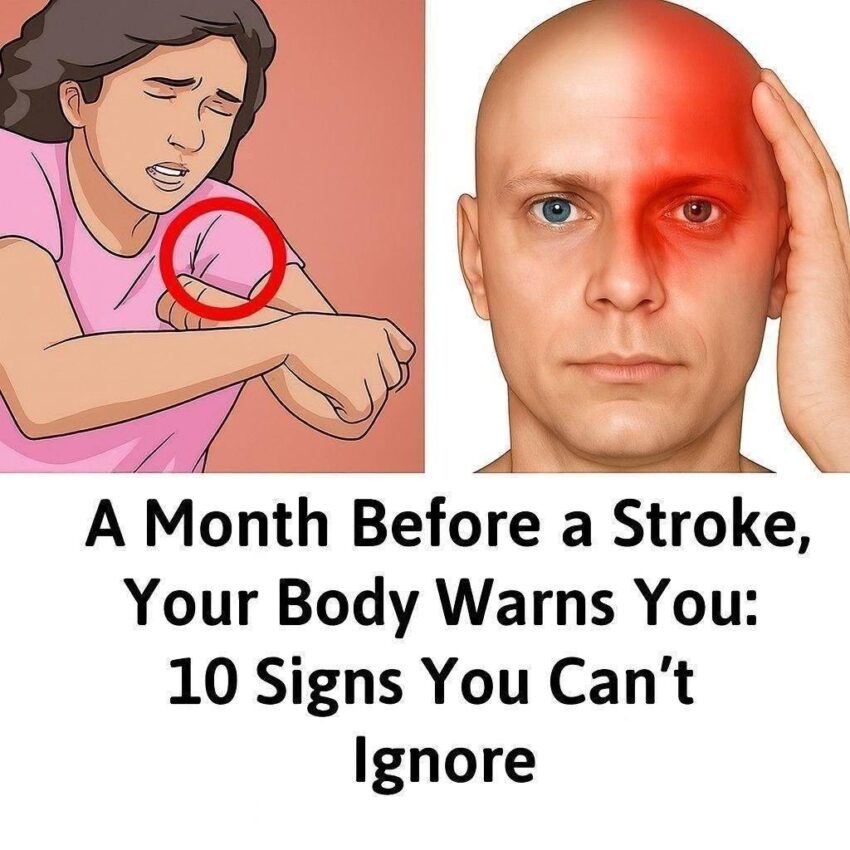
Stroke risk is real, but the idea that there’s a reliable “1 month warning list” is misleading. A stroke can come suddenly, or it can be preceded by warning signs—especially a mini-stroke (Transient Ischemic Attack, or TIA). These warning signs matter because they can signal an urgent risk of a full Stroke.
Here are 10 important warning signs you should never ignore, whether they happen days or weeks before:
⚠️ 1. Sudden weakness or numbness
Especially on one side of the face, arm, or leg.
⚠️ 2. Face drooping
One side of the face may feel uneven or “slumped.”
⚠️ 3. Speech problems
Slurred speech, confusion, or difficulty finding words.
⚠️ 4. Sudden vision changes
Blurred vision, double vision, or loss of sight in one eye.
⚠️ 5. Severe unexplained headache
A sudden “worst headache of your life” can be a warning.
⚠️ 6. Dizziness or loss of balance
Trouble walking, coordination issues, or sudden unsteadiness.
⚠️ 7. Brief episodes of weakness or numbness (TIA signs)
Symptoms that disappear after minutes or hours are still serious.
⚠️ 8. Trouble understanding speech
You hear words but can’t process meaning clearly.
⚠️ 9. Sudden confusion
Disorientation or unusual difficulty thinking clearly.
⚠️ 10. Sudden fatigue or collapse feeling
A sudden “drained” feeling without clear cause.
🧠 Key reality check
- These symptoms are not a guaranteed 1-month warning system
- But they can be early signals of a serious vascular problem
- A TIA is especially important because it often happens before a full stroke
🚨 When to act immediately
If any of these appear suddenly, even if they go away:
- Call emergency services right away
- Do not wait for symptoms to return
- Time matters for brain survival
🧭 Simple memory tool: FAST (for Stroke)
- Face drooping
- Arm weakness
- Speech difficulty
- Time to call emergency help
💡 Bottom line
The safest interpretation is not “10 signs a month before,” but:
Any sudden neurological change = urgent medical evaluation.
If you want, I can also explain early risk factors for stroke (like blood pressure, diabetes, or lifestyle signs) or how to reduce risk long-term.